APSG 2007
International Symposium of the
ASIA PACIFIC SPACE GEODYNAMICS
1 - 3 November, 2007
Indian Institute of Technology Bombay, MUMBAI - 400076, India.
Details coming soon!!
Contact:
Prof. Madhav N. Kulkarni,
Dept. of Civil Engineering, IIT Bombay
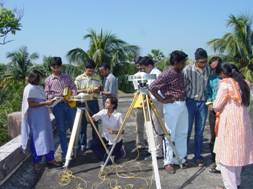

Click on the photo for website link
Introduction for Asia-Pacific Space Geodynamics Program
Introduction and Rational
The Asian-Pacific area, primarily the western Pacific boundary zone including China, Japan, and Southeast Asia, and the northern Indian Ocean boundary zone including the Tibetan Plateau of China and Southeast Asia, is the convergence zone of four plates: Eurasian, Pacific, Philippine and Indo-Australian. The region also includes a major portion of the tectonic system that is responsible for new activity in the Round-Pacific and the Alps-Himalayas mountain-building zones. The area is characterized by complex tectonics, violent crustal motion, frequent and fierce earthquakes, and devastating volcanic activity. In this area there is dense population, rapidly developing economics, and yet frequent and serious natural hazards (earthquakes, volcanic eruptions, sea immersion, etc.). Therefore this area is one of the most appropriate and urgent regions for research in tectonic and crustal motion, local deformation, sea-level change and their effects on the existing human environment. The main objective of the Asia-Pacific Space Geodynamics (APSG) Program is to unite all relevant activities in the region into a cooperative research project in plate tectonic, crustal motion and deformation, and sea level change in the area. This will provide a synergistic umbrella for scientists in the region to cooperate and to contribute to the better understanding of the processes involved and better prediction of major disastrous events. A major impetus for this program has been the emergence of space geodetic techniques with mm measurement capability.
All countries in the Asia-Pacific area are urged to join in this project, while countries outside the area are warmly invited to participate. The project will promote international academic exchange and scientific cooperation, and will contribute to the scientific research level of the developing countries in this area.
The primary objectives of study for the APSG are to:
1. measure and monitor, using space techniques, the relative motion between the Eurasian, Pacific, Philippine, and Indo-Australian plates including the plate tectonic motion along the boundaries, as well as local crustal deformation;
2. study the evolution and dynamics of the crustal motion of the island-arc system in the Western Pacific boundary zone and the mountain-building zones of the Tibetan Plateau and Southeast Asia;
3. measure and monitor sea-level change in the Asia-Pacific region using space techniques including altimetry and tide gauge data to study the characteristics and causes of the fluctuations in global sea surface;
4. investigate the dynamics of the Earth as a whole (Earth rotation, gravity changes, etc.) and the mass motions within each layer (including the atmosphere, oceans, lithosphere, mantle, and the core) and their dynamic relations; and
5. investigate natural hazards (earthquakes, volcanic eruptions, sea immersion, etc.) in the region as well as their relation with various Earth motions, and provide basic information for the prediction of natural disasters.
APSG Central Bureau:
Address: 80 Nandan Rd., Shanghai 200030, P.R.China
Tel: 86-21-64876588 ; Fax: 86-21-64384618
E-mail: apsg@center.shao.ac.cn
Web site: http://center.shao.ac.cn/APSG